LUNOS on Lakebase: a shorter path from insurance operations to governed intelligence
How LUNOS on Lakebase reduces data-movement complexity, external handoffs, and time to trusted insight
OCTOBER 2026
Executive perspective
One traceable path.
KEY INSIGHT
LUNOS preserves insurance context in Lakebase; Databricks turns operational change into governed evidence for decisions — with fewer external handoffs.
Silvermoon has configured LUNOS to run its operational transaction workload on Lakebase Postgres, bringing LUNOS operational data and Databricks analytics into a common Databricks platform architecture while preserving separate transactional and analytical workloads. Lakebase provides a native route for operational change to become governed analytical evidence without a separately operated external CDC stack. Silvermoon is not aware of a published example of an insurance policy administration platform running its OLTP workload on Lakebase.
01 OPERATE IN CONTEXT
LUNOS executes insurance transactions on Lakebase Postgres OLTP.
02 CAPTURE CHANGE
Lakebase CDF writes change history to Unity Catalog Delta.
03 GOVERN + DECIDE
Databricks reconciles, refines and serves trusted measures, dashboards and actions.
01 | THE DATABRICKS-NATIVE ARCHITECTURE
The strategic difference is where the operational data starts
A native path removes external CDC complexity while preserving distinct transactional and analytical responsibilities.
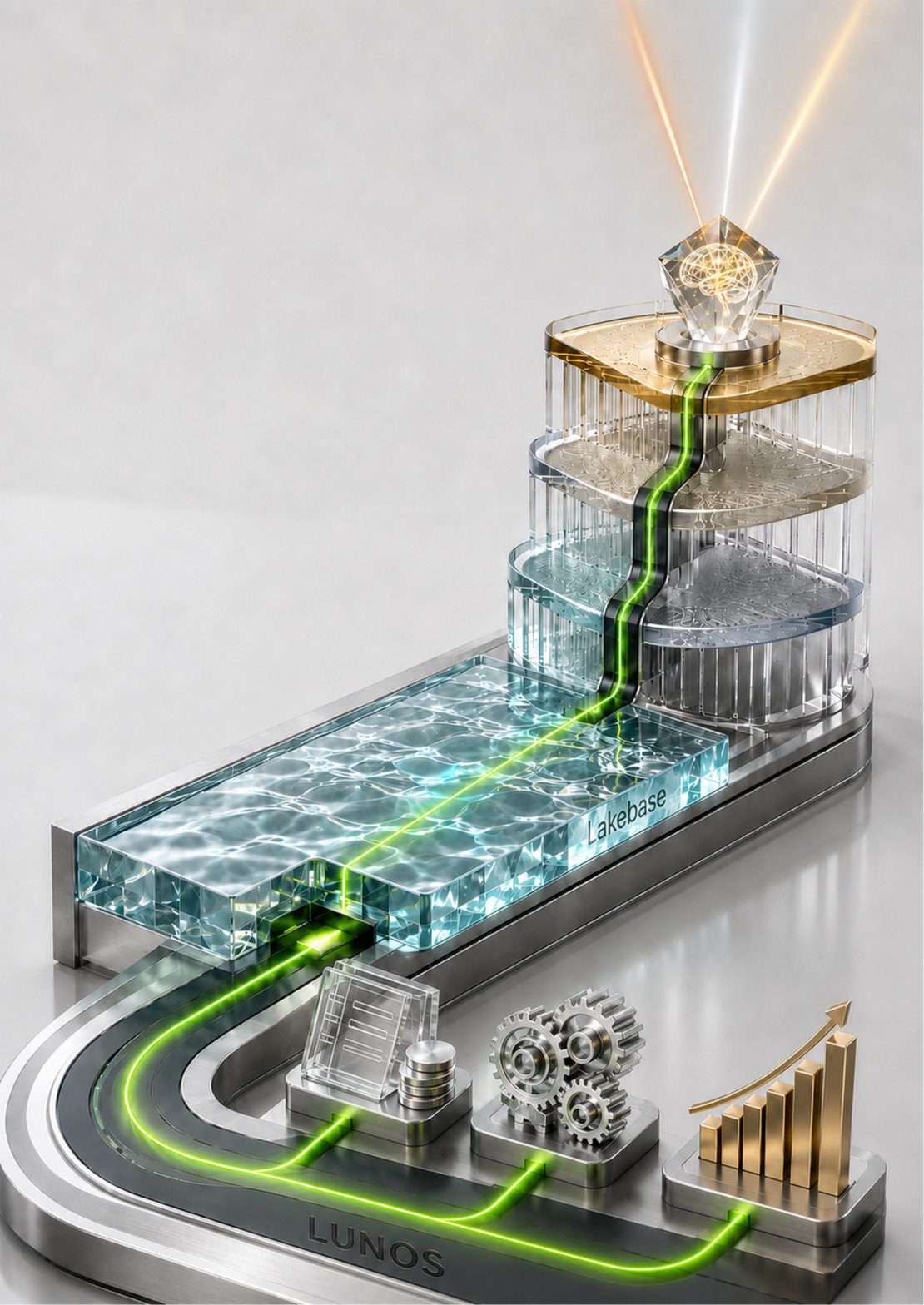
Silvermoon configured LUNOS to use Lakebase Postgres as its OLTP database. Because Lakebase is native to Databricks, operational change enters Unity Catalog Delta tables through Lakebase Change Data Feed rather than a separately operated external CDC stack. This shortens the route from insurance transaction to governed analysis while preserving distinct operational and analytical workloads.
1 | LUNOS OPERATIONS
Insurance-native transactions
Party, Policy Management, Claim Management, and Financials.
2 | LAKEBASE OLTP
LUNOS operational database
Managed PostgreSQL on the Databricks platform.
3 | NATIVE CHANGE PATH
Operational change to Delta evidence
Lakebase CDF writes change history to Unity Catalog.
4 | GOVERNED INTELLIGENCE
Bronze • Silver • Gold
Reconcile, govern, define measures, dashboard and act.
WHY THE ARCHITECTURE IS STRATEGICALLY DIFFERENT
Fewer external handoffs
Operational and analytical services sit on the same platform
Shorter evidence path
Operational change becomes available for governed downstream use
Explicit control points
Keys, change history and reconciliation remain visible end to end
Traceable decisions
Measures and actions trace back to operational evidence
Why LUNOS makes the path more valuable
The advantage is not proximity alone. LUNOS gives each party, policy, lifecycle event and financial transaction an explicit place and relationship. Downstream analytics begins with insurance meaning already encoded in the operational record, reducing the reconstruction needed before measures can be trusted.
Insurance-native semantics
Parties, Policies, Claims, Events and Money retain their business relationships
Lifecycle discipline
Effective dates, versions and status preserve the contract story over time
Reusable domain services
Shared domain services reduce repeated implementations while allowing controlled extensions
Headless, service-led design
Channels use common policy and lifecycle logic through APIs and events.
02 | THE INSURANCE DATA-TO-DECISION GAP
The problem is the distance between transaction and decision
Valuable operational data often loses immediacy and insurance context as it crosses systems, extracts and reporting layers.
Insurers generate valuable information across customer interactions, quotations, policies, premiums, claims, payments and service activity. Yet this information often spans operational systems, external replication layers, reporting tools and manually maintained processes. By the time it is reconciled and converted into management information, it may have lost both immediacy and insurance context.
This creates more than a reporting problem. Operations see bottlenecks late; finance reconciles competing figures; business teams struggle to trace results to the records and rules that produced them; and technology teams maintain duplicated pipelines, extracts and business logic. Leadership may see several technically correct numbers without a single explanation of how they relate to the customer, policy or underlying event.
CENTRAL CHALLENGE
Make operational insurance data securely available for analysis without disrupting transaction processing, duplicating core logic or creating another disconnected information layer.
A shorter path creates value through four executive lenses
BUSINESS VALUE
Connected customer and portfolio evidence supports growth choices and portfolio priorities.
OPERATIONAL PERFORMANCE
Visible lifecycle, workload and exception signals support faster intervention.
FINANCIAL CONTROL
Policy- and Claim-linked financial activity strengthens reconciliation and cost insight.
TECHNOLOGY RESILIENCE
Clear workload separation, lineage and ownership reduce reporting fragility.
03 | WHY DATABRICKS COMPLEMENTS LUNOS
One platform, two workloads, clear accountability
Databricks does not replace LUNOS; it provides the complementary data-product and governance path.
The LUNOS model is deliberately normalized for transactional integrity, reuse and precise relationships. Databricks provides the complementary path: capture operational change, improve quality progressively, govern access and lineage, define reusable measures, and present information through analytics, dashboards or approved operational signals. The two workloads remain accountable for different jobs even when they share one platform.
LUNOS
OPERATIONAL TRUTH
Executes policy and claim lifecycles; preserves party, event and financial context; protects transaction integrity.
LAKEBASE POSTGRES
OPERATIONAL DATA
Provides managed Postgres for low-latency applications, with standard connectivity, branches, scaling and lakehouse integration.
DATABRICKS LAKEHOUSE
GOVERNED INTELLIGENCE
Refines data for analytics; governs access and lineage; defines metrics; orchestrates refreshes; serves dashboards and downstream decisions.
Bronze, Silver, and Gold make three different business promises
BRONZE | PRESERVE
“What did the source say?”
Raw operational history, source keys, load metadata and reconciliation evidence.
SILVER | CONNECT
“Can we trust the detail?”
Validated relationships, conformed events and owned exceptions.
GOLD | DECIDE
“What should we do?”
Business-ready facts, governed metrics, dashboards and action paths.
NATIVE ADVANTAGE
Lakebase CDF stores Postgres changes as Unity Catalog Delta tables, removing the need for an external CDC stack.
04 | HOW THE COMBINED ARCHITECTURE WORKS
Five stages, five explicit evidence gates
The route is credible only when every step from LUNOS transaction to accountable action has an owner and evidence.
The diagram and evidence fields below use the same five stages. A shorter path is not a shortcut around architecture discipline.
01 TRANSACT
LUNOS records policy state, parties, claims, requests, events and money in its Lakebase operational database.
EVIDENCE GATE
Domain-owner and transaction evidence
02 CAPTURE
Lakebase CDF or an approved route captures database change with source keys, history and load metadata.
EVIDENCE GATE
Counts and amounts reconcile to LUNOS
03 REFINE
Bronze preserves source evidence; Silver validates and connects it; Gold prepares decision-ready datasets.
EVIDENCE GATE
Quality rules and exceptions are owned
04 GOVERN
Unity Catalog controls access, lineage and reusable measures; orchestration makes cadence visible.
EVIDENCE GATE
Access, lineage and metric owners approved
05 DECIDE + ACT
Dashboards, alerts, models or operational signals support a named decision and action path.
EVIDENCE GATE
Use, outcome and exception handling measured
ARCHITECTURE BOUNDARY
Serve complex history and large aggregations from analytical datasets, not the transaction path. Approved insights may return through APIs, events or appropriate read-oriented Lakebase patterns such as synced tables.
05 | FROM BUSINESS QUESTION TO GOVERNED DASHBOARD
A dashboard is the final layer, not the starting point
A dependable dashboard is a small data product with definitions, lineage, service levels and accountable ownership.
Architecture creates opportunity; a dashboard creates value only when it supports a decision. It must trace back to operational records, refresh to an explicit service level and have an owner when the number is wrong. The work is therefore as much about semantics, controls and accountability as visual design.
01Decide and define
Name the decision, action, owner, formula, grain, filters, privacy class and acceptance example.
02Map the LUNOS context
Identify party, policy, product, event and financial keys; document versions, states, timestamps and joins.
03Capture and reconcile
Use an approved route; preserve source shape in Bronze; reconcile records, amounts and change windows to LUNOS.
04Conform and assure
Standardize codes and dates in Silver; resolve relationships; apply quality rules and route exceptions to owners.
05Define and present
Create Gold datasets and governed measures; build role-based views with filters, drill paths and masking.
06Operate and improve
Schedule refreshes; monitor failures, data quality, performance, cost and use; version measures as rules change.
OPERATING PRINCIPLE
One trace should connect the leadership question to the formula, the source operational record, the transformation logic, the dashboard and the named action.
The strongest dashboards make the evidence path visible before the visual treatment is celebrated.
What makes the output decision-grade
Decision-grade information combines a trusted number, a clear owner and an agreed response.
01One metric owner and one action owner
The person accountable for the number may not be the person accountable for the response.
02A complete measure definition
Document grain, formula, inclusion logic, effective date and expected refresh time.
03Reconciliation with visible exceptions
Reconcile LUNOS operational records and downstream datasets with owned tolerances.
04Role-based protection
Align access, classification, masking and audit to customer and financial-data sensitivity.
05End-to-end lineage
Trace source through transformation to dashboard for impact and root-cause analysis.
06Proportionate operations
Monitor refresh frequency, experience, performance, cost and use against decision value.
Four leadership views of the same governed evidence
GROWTH AND VALUE
Customer opportunity, product traction, retention signals and portfolio mix.
OPERATIONAL PERFORMANCE
Cycle times, service demand, exceptions, backlogs and process outcomes.
FINANCIAL STEWARDSHIP
Premiums, collections, reconciliation, cost-to-serve and investment choices.
TECHNOLOGY CONTROL
Data quality, job health, lineage, usage, capacity and platform cost.
06 | WHAT WE DEMONSTRATED
The controlled proof established an end-to-end operational-to-analytics path
The proof tested LUNOS on Lakebase, Databricks serverless infrastructure using a medallion architecture for analytics.
PROOF ENVIRONMENT
Silvermoon provisioned a Databricks account hosted on AWS and used Databricks serverless infrastructure. The LUNOS operational database was implemented on Lakebase Postgres as the OLTP layer, and LUNOS continued to execute its operational behavior as expected.
01Run LUNOS on Lakebase
Operational transactions executed against the Lakebase Postgres configuration.
02Carry required tables to Bronze
Because Lakebase is native to Databricks, no separate connectivity integration was required; no integration issues were encountered in the proof environment.
03Preserve source-shaped evidence
Bronze retained operational records, source keys and the starting point for reconciliation.
04Connect insurance context
Silver views connected and standardized parties, policies, roles, financial transactions and customer relationships.
05Prepare decision-ready output
Gold-level datasets and queries supported dashboards, analytics and governed reporting.
LUNOS ran on a Databricks-aligned operational architecture, and its insurance semantics moved into analytical layers without losing the context needed for traceability.
The proof connected operational context to practical leadership insight
Analytical views were created across parties, policies, financial transactions, ledger records and customer relationships. Within the controlled proof environment, AI-assisted query development supported the construction of views and dashboard content; all output was reviewed by Silvermoon Data Specialists before use.
CUSTOMER 360
Bring customer context into one analytical view
LUNOS party data, agreement roles, financial information and related customer context were brought together into a single analytical view.
LEAD GENERATION
Turn existing relationships into opportunity signals
Existing parties, current policies and product opportunities were analyzed to identify potential sales and servicing opportunities.
What the proof established
- LUNOS operational data is surfaced in Databricks and transformed into governed dashboards.
- Insurance semantics — including parties, relationships, policies, roles and financial activity — remains traceable.
- Databricks BI capabilities supports Customer 360 insight and actionable lead-generation intelligence.
WHAT REMAINS TO BE VALIDATED
Production scale, resilience, security controls, pipeline refresh frequency, monitoring and support procedures, reconciliation tolerances and cost. The work is a demonstrated proof path — not a production benchmark.
07 | A CONTROLLED PROOF PATH FROM OPERATIONS TO DECISION
Prove one complete operational thread before scaling
The strongest proof is narrow but vertically complete: one journey, a small set of decisions and evidence from transaction through action.
Silvermoon demonstrated an architecture in which LUNOS operational insurance transactions run on Lakebase Postgres and flow into Databricks analytics through a governed change path. This creates a shorter and more traceable route from policy, party, claim and financial activity to decision-grade dashboards and operational intelligence.
DEFINE
Agree the business question, operational journey, success measure, action owner and authoritative sources.
EVIDENCE
Approved definitions and acceptance examples
EXECUTE
Provide representative policy, party, claim, lifecycle and financial behavior in LUNOS.
EVIDENCE
Domain-owner and functional sign-off
CONNECT
Validate LUNOS on Lakebase, native change capture, network path, identity, cadence and reconciliation.
EVIDENCE
Security, load, freshness, recovery and cost evidence
GOVERN
Build Bronze, Silver, and Gold with contracts, quality controls, access, lineage, metrics and orchestration.
EVIDENCE
Numbers reconcile; exceptions have owners
ACT + LEARN
Publish a dashboard, alert or governed signal; observe intended use and whether the action helps.
EVIDENCE
Use and outcome measured; reuse assessed
EVIDENCE DISCIPLINE
Keep evidence labels clear: demonstrated, documented and proposed. Use representative evidence before making production performance, resilience, compliance, integration or outcome claims.
08 | LEADERSHIP CONCLUSION
The strategic proposition is fewer moving parts with end-to-end traceability
The business case should rest on a measurable reduction in operation-to-decision distance.
LUNOS is strongest where operational insurance meaning must remain explicit: which policy or claim is involved, who played each role, what changed and how money moved. Each party has one explicit and unique home in LUNOS even when connected to multiple types of agreements (for example a producer agreement) or policies, claims or intermediary relationships; the operational record preserves the context needed to explain every downstream number.
The differentiated architecture goes further than placing an operational platform beside an analytical one. LUNOS runs its transactional workload on Lakebase Postgres; Lakebase Change Data Feed provides a native route for changes to become Unity Catalog Delta evidence for downstream pipelines and audit. Databricks then reconciles and governs that evidence, defines reusable measures and delivers dashboards or approved signals. The advantage is a native route with fewer integration components while governance and control obligations remain explicit.
Fewer cross-platform handoffs • less bespoke data-movement plumbing • clearer operational context • more reliable reconciliation • faster access to service or growth signals • lower integration and operating cost
FINAL TAKEAWAY
- A simpler native path reduces the moving parts required to land operational data in governed analytics — while preserving traceability from transaction to accountable action.
- LUNOS already runs on Amazon RDS for PostgreSQL, IBM Db2 and Oracle Database. Standing it up on Lakebase took under four hours — the same order of effort. The difference is what happens next: the governed analytics path is already in place rather than waiting on a second integration project.
Continue the conversation
Explore a controlled proof path that connects one representative insurance journey to governed leadership decisions — with evidence gates from transaction through action.
ABOUT SILVERMOON
Silvermoon Software Solutions develops LUNOS, an insurance-native platform designed around explicit parties, agreements or policies, claims, lifecycle events and financial transactions. This paper presents Silvermoon’s demonstrated path from LUNOS transactions on Lakebase to governed Databricks intelligence.
Learn more about LUNOS: silvermoongroup.com/software-lunos
References
Silvermoon — LUNOS product overview
Databricks — Lakebase Postgres
Databricks — Medallion architecture
Databricks — Unity Catalog governance
PUBLICATION BOUNDARY + TRADEMARKS
The architecture has been demonstrated in a controlled proof environment. Production performance, resilience, security, refresh, reconciliation and cost remain subject to representative validation. Databricks, Lakebase, Unity Catalog, Delta Lake, Lakeflow and the Databricks logo are trademarks of Databricks, Inc. PostgreSQL and the Slonik logo are trademarks of the PostgreSQL Community Association of Canada. AWS and Amazon Web Services are trademarks of Amazon.com, Inc. or its affiliates. LUNOS and Silvermoon are trademarks of Silvermoon Software Solutions BV. All other trademarks are the property of their respective owners.
© Silvermoon Software Solutions BV 2007–2026. All rights reserved.